
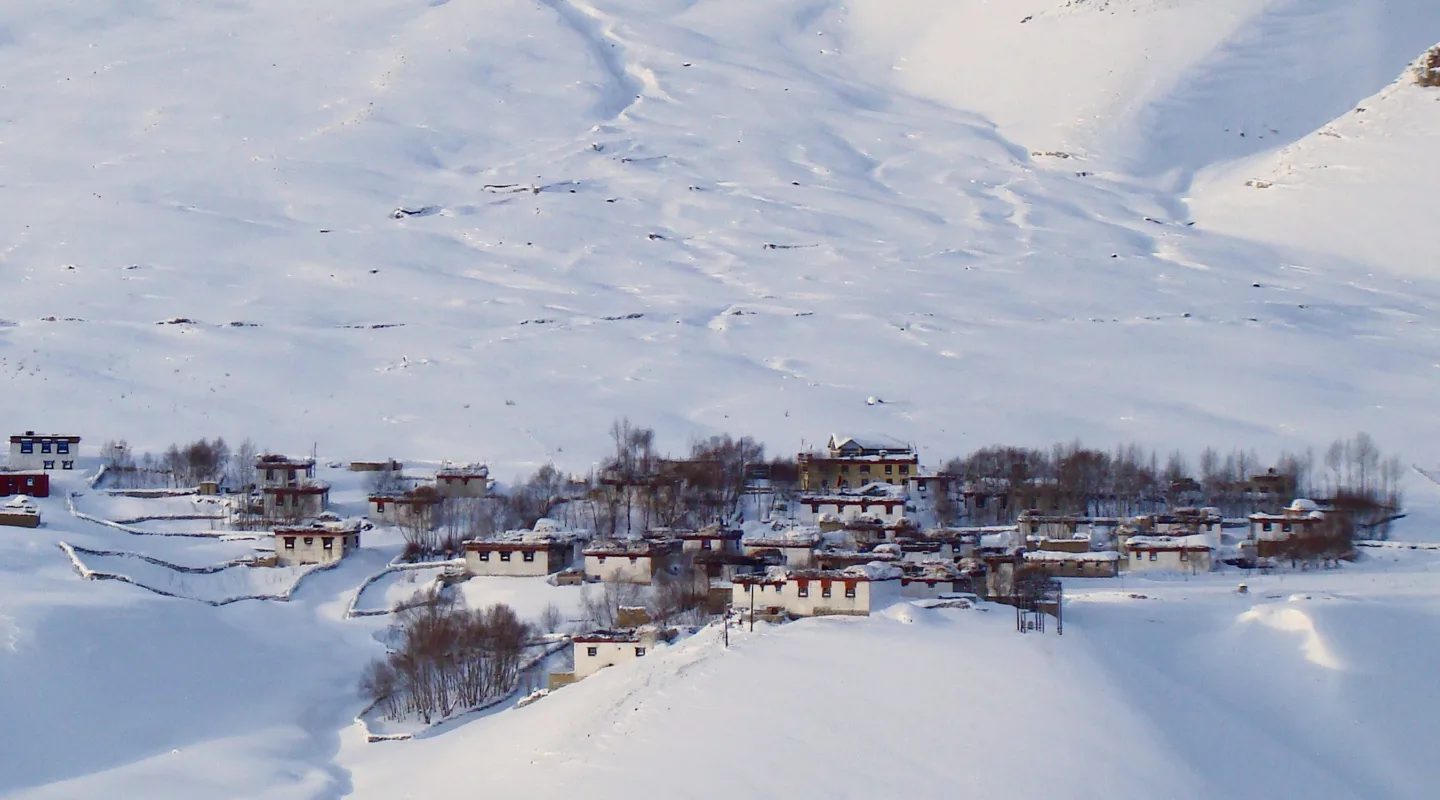

Between November and March, Spiti Valley stops being a high-altitude desert and becomes something closer to a frozen moonscape. The winter Spiti road trip is the only way to see it in that state, and it is a genuinely different journey from the summer version — different route, different roads, different villages, and a fraction of the traffic. This guide covers the real 9-day route, the altitude, what stays open, and how the departures work.
Why winter is the season to see Spiti
Summer Spiti is beautiful but busy. Winter Spiti is quiet in a way that is hard to describe: villages of forty families, monasteries under two metres of snow, and long stretches of road where yours are the only tyre tracks. The light is low and blue for most of the day, which is why photographers rate this trip so highly.
It is also the season for snow leopards. Between January and March, the cats come down to lower elevations around Kibber and Chicham, and sightings — while never guaranteed — are realistic on a well-run trip.
Winter Spiti road trip at a glance
| Duration | 9 days / 8 nights |
|---|---|
| Route | Delhi – Shimla – Sangla – Chitkul – Khab – Nako – Tabo – Kaza – Kalpa – Shimla – Delhi |
| Price | ₹15,999 per person |
| Maximum altitude | Approx. 16,500 ft |
| Difficulty | Difficult — cold, remote and long driving days |
| Maximum group size | 12 travellers |
| Best months | November to March |
| Rating | 4.8 / 5 from 489 traveller reviews |
Day-by-day itinerary
Day 1 — Delhi to Shimla
An overnight or early-morning drive from Delhi to Shimla, where you acclimatise and pick up the last of your winter layers. Shimla is the staging point because the winter route runs through Kinnaur, not through Manali.
Day 2 — Shimla to Sangla
The road follows the Sutlej into Kinnaur. Sangla sits in the Baspa valley and is the first place the landscape turns properly alpine. Expect the temperature to drop sharply after Karcham.
Day 3 — Chitkul, Khab, Nako and Tabo
Chitkul is the last village on the old Hindustan–Tibet road and the coldest inhabited place in the valley. From there the route runs through Khab, where the Spiti and Sutlej rivers meet, then Nako and on to Tabo — home to a 1,000-year-old monastery whose murals are among the finest in the Himalaya.
Day 4 — Tabo, Dhankhar, Pin Valley and Kaza
Dhankhar monastery sits on a cliff above the confluence of the Spiti and Pin rivers. The detour into Pin Valley is where you have the best chance of spotting wildlife in winter. You end the day in Kaza, the administrative headquarters of Spiti and your base for the next three nights.
Day 5 — Kaza, Langza, Komic and Hikkim
The classic high-village loop. Langza has the fossil beds and the giant Buddha statue; Komic is one of the highest inhabited villages in the world; and Hikkim is home to the highest functioning post office on earth at 4,440 m, where you can still post a card that will actually arrive.
Day 6 — Kaza, Key, Kibber and Chicham
Key monastery is the largest in Spiti and the most photographed. Kibber and Chicham sit across the gorge, linked by one of the highest suspension bridges in Asia. This is prime snow-leopard country in January and March.
Day 7 — Kaza to Kalpa
You retrace the valley towards Kinnaur and stop at Kalpa, where the Kinner Kailash range fills the entire skyline from the hotel windows. Sunset here is the visual high point of the trip.
Day 8 — Kalpa to Shimla, then departure for Delhi
A long drive back down the Sutlej, then the overnight run to Delhi.
Day 9 — Arrival in Delhi
You reach Delhi in the morning.
What is open in winter — and what is not
Chandratal Lake is not accessible in winter; the Kunzum Pass road closes and the lake is under snow. The winter route deliberately avoids it. Rohtang and the Manali approach are also closed, which is why the trip runs via Shimla and Kinnaur. Mobile coverage is patchy to non-existent beyond Kaza, and most homestays run on solar with limited hot water.
How cold does it get?
Daytime temperatures in Kaza sit between -5°C and 5°C in December and January, dropping to -20°C or lower at night. The trip is rated difficult for that reason, not for physical exertion — the walking is minimal, but the cold is real and the driving days are long.
If you want Spiti without the deep winter, the Spiti Valley trip from Delhi runs the summer route. For a gentler Kinnaur introduction, see the Sangla Chitkul Kalpa trip, and for a snow trek at lower altitude, the Kuari Pass trek.
Departures and booking
The Winter Spiti road trip runs 27 departures between November and May, with 6–12 seats per batch and a base price of ₹15,999 per person. Full dates and availability are on the Winter Spiti Road Trip page.
What the winter route actually looks like
The Shimla–Kinnaur–Kaza road is the only reliable winter approach to Spiti. It follows the Sutlej gorge through Rampur and Karcham, turns up the Baspa valley at Sangla, and rejoins the main river at Khab before climbing to Nako and Tabo. The road is cut into the gorge wall for long stretches, and in winter the shaded sections hold ice well into the afternoon.
This is why the trip is nine days rather than the six a summer circuit takes: the driving is slower, the days are shorter, and the itinerary builds in buffer.
Accommodation and food in winter
You stay in homestays and small guesthouses rather than camps. Most Spitian homes have a bukhari — a wood or dung stove in the central room — and the family will keep it lit through the evening. Rooms are cold at night; the sleeping bag you bring matters more than the blanket provided.
Food is simple and good: thukpa, momos, rajma with rice, and butter tea. Vegetarian food is easy everywhere. If you have specific dietary needs, tell the operator when booking, because the villages stock what they stock and there is no shop to fall back on in February.
Permits and paperwork
Indian nationals do not need a permit for Spiti itself, but the inner-line areas beyond Kaza towards the Chinese border do require one, and the operator arranges it. Carry photo ID — a driving licence or Aadhaar — because it is checked at the Kinnaur entry points. Foreign nationals need a protected-area permit, which the operator can also arrange with advance notice.
Hero photograph: Khurik village in winter by Ksuryawanshi, CC BY-SA 3.0, via Wikimedia Commons.
Frequently asked questions
What does this guide to Winter Spiti Road Trip cover?
Between November and March, Spiti Valley stops being a high-altitude desert and becomes something closer to a frozen moonscape.
What are the main things covered in this Winter Spiti Road Trip guide?
The guide walks through Why winter is the season to see Spiti, Winter Spiti road trip at a glance, Day-by-day itinerary, Day 1 — Delhi to Shimla and Day 2 — Shimla to Sangla.
Which months does this guide recommend?
The months discussed are January, February, March, May, November and December. Conditions outside those windows change the route, so check the current status before you plan travel.
How hard is the route described here?
The guide rates it difficult. Match that against your own fitness and recent walking before you commit to dates.
How do I book the trip described in this guide?
Open the trip page linked in the article, pick a departure that suits you and book online, or message us on WhatsApp with your dates and group size and we will confirm availability.
What does this trip cost?
The guide quotes ₹15,999 per person. The live price and what it includes are on the linked trip page, since rates change by season.
