
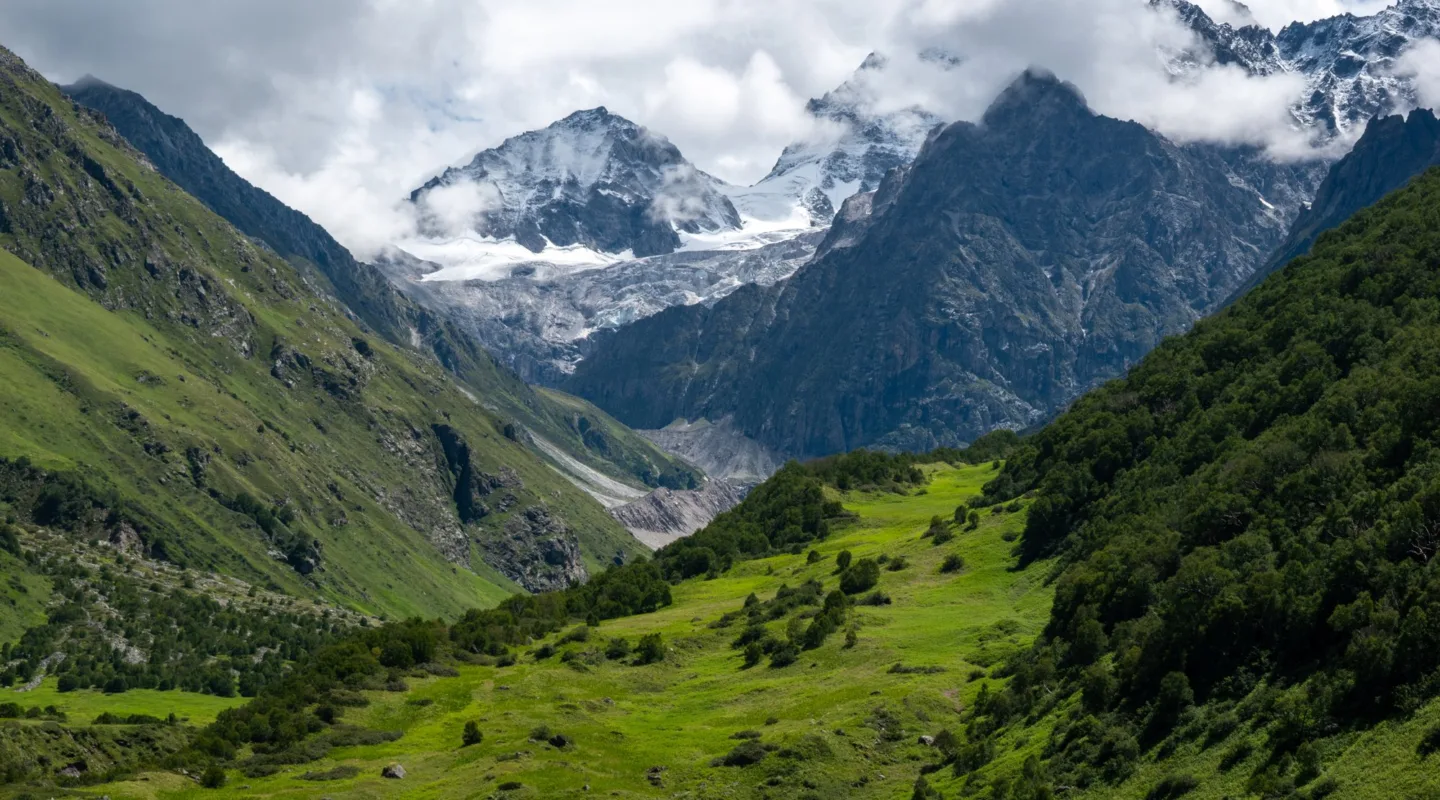

The Valley of Flowers is the rare Indian trek where the destination is not a summit. You walk into a hanging valley in the Chamoli district of Uttarakhand, and for a few weeks each monsoon the floor of that valley turns into a carpet of more than 600 species of alpine wildflowers. It was declared a UNESCO World Heritage Site in 2005 and sits inside the Nanda Devi Biosphere Reserve, which is why the park is fenced, permitted and open for only part of the year.
This guide covers the real numbers from our own 6-day departure — the cost, the day-by-day route, where the trail actually gets hard, and how to decide whether to add the Hemkund Sahib climb on day four.
Valley of Flowers at a Glance
| Detail | Information |
|---|---|
| Duration | 6 days / 5 nights |
| Price | ₹9,500 per person |
| Difficulty | Moderate (easy-to-moderate walking, one steep day) |
| Valley altitude | 3,658 m (12,000 ft) |
| Highest point | Hemkund Sahib, 4,329 m (14,200 ft) |
| Total trekking distance | Approximately 38 km round trip |
| Location | Chamoli district, Uttarakhand |
| Base for the walk | Govindghat, reached by road from Rishikesh |
| Group size | Maximum 12 travellers |
| Best months | July to September, peaking in August |
Where the Valley of Flowers Actually Is
The trailhead is Govindghat on the Rishikesh–Badrinath highway, roughly 270 km from Rishikesh. From Govindghat you walk 10 km up the Pushpawati valley to Ghangaria, a small settlement of guesthouses and dhabas that serves as the base for both the Valley of Flowers and Hemkund Sahib. Everything beyond Ghangaria is on foot or by pony and helicopter for the Hemkund leg.
Ghangaria is the only place you sleep for three consecutive nights, which is worth knowing before you pack — you can leave a bag there and carry a day pack into the valley.
The 6-Day Itinerary, Day by Day
Day 1: Rishikesh to Joshimath
A long road day of about 270 km through Devprayag, Rudraprayag, Karnaprayag and Joshimath. You overnight at Joshimath, which also helps with acclimatisation before the climb.
Day 2: Joshimath to Govindghat, trek to Ghangaria
A short drive to Govindghat, then the first real walking day: 10 km along the Pushpawati river through forest, waterfalls and small villages. The gradient is gentle but relentless, and this is the day most people discover whether their shoes fit properly.
Day 3: Ghangaria to the Valley of Flowers and back
The reason you came. A 10 km round trip into the national park, climbing steadily for the first hour before the valley opens out. You spend the middle of the day among the meadows, then walk back to Ghangaria. Carry your own water — there are no shops inside the park.
Day 4: Ghangaria to Hemkund Sahib and back
The hardest day of the trip: 12 km round trip with a steep, sustained climb to 4,329 m. The stone path switchbacks for most of the way. At the top is the Gurudwara beside a glacial lake, one of the highest shrines in the world. If the altitude is affecting you, turning back at the halfway point is a perfectly reasonable decision — the valley on day three is the main event.
Day 5: Ghangaria to Govindghat, drive to Joshimath
Descend the 10 km you climbed on day two, then drive back to Joshimath. Knees, not lungs, are the limiting factor here.
Day 6: Joshimath to Rishikesh
The return drive, retracing the confluences. Trip ends in Rishikesh.
How Hard Is the Valley of Flowers Trek?
It is rated moderate, and that is honest rather than marketing. The valley walk itself is well-defined stone path with gradual ascents and bridged river crossings, and daily walking is 5 to 7 hours. What makes it feel harder than the gradient suggests is the altitude at Ghangaria (about 3,050 m) and the single steep day to Hemkund.
Basic fitness is enough. If you can walk 8 to 10 km on hilly ground without stopping, you will manage. Build three to four weeks of walking, stair climbing or cycling into your routine before you go, and the trip becomes comfortable rather than a struggle.
When to Go: The Flower Calendar
The park is only open for a few months, and the timing changes what you see.
- July — the valley greens up after the monsoon arrives. Fewer flowers, lush landscape, more rain.
- August — peak bloom. This is the month the postcards are taken in, and the busiest window.
- September — flowers begin to fade but the mountain views clear up and the weather is more stable.
If flowers are the priority, aim for the second half of August. If you want clear peaks and fewer people, September is the better trade.
What You Will Actually See
The famous species are the blue poppy, Brahma Kamal, cobra lily, Himalayan bellflower, marsh marigold, primulas, Himalayan geranium and anemones. Wildlife is harder to spot but the Himalayan monal is common around Ghangaria, and blue sheep, musk deer and (very rarely) snow leopard live in the reserve.
Photographers should note that the valley is at its most photogenic in flat, overcast light — the harsh midday sun of a clear day blows out the flower colour.
What to Carry
Rain is the defining feature of this trek, so a waterproof shell and a poncho matter more than any other item. Add thermal wear, a fleece, trek pants, a woollen cap and gloves for the Hemkund morning, plus trekking shoes with grip, a pole, a water bottle, SPF 50+ sunscreen, sunglasses, personal medicines and a power bank. Charging points in Ghangaria are unreliable.
What the Package Covers
The ₹9,500 covers a naturalist guide, a mix of guesthouses and camps, all meals, and the National Park permit for the Nanda Devi Biosphere Reserve. Transport to Govindghat, pony or porter charges for personal bags, and anything not listed are extra — budget for those separately.
Frequently Asked Questions
Is the Valley of Flowers trek suitable for beginners?
Yes. It is one of the most beginner-friendly Himalayan treks, with well-defined paths and gradual ascents. The only genuinely demanding section is the Hemkund Sahib climb on day four, which you can skip.
How many days does the Valley of Flowers trek take?
Six days and five nights from Rishikesh, including two road days at each end. The walking itself is three days: Govindghat to Ghangaria, the valley, and Hemkund.
What is the best month to see flowers in the Valley of Flowers?
August, when the valley is at peak bloom. July is greener but has fewer flowers, and September offers clearer mountain views as the blooms fade.
Do I need a permit for the Valley of Flowers?
Yes. The valley is inside a national park and a UNESCO World Heritage Site, so an entry permit is required. It is included in our package and arranged at Govindghat.
Planning Your Trip
If you want the full day-by-day plan, inclusions and current departure dates, see the Valley of Flowers trek page. If you are comparing Uttarakhand options, our Chopta Tungnath trek is a shorter summit alternative, the Har Ki Dun trek suits a similar season with a different landscape, and the Deoriatal Chandrashila trek gives you a summit view of Chaukhamba in half the days.
Hero photograph: Valley of Flowers National Park, Uttarakhand by Rohit Sharma, CC BY-SA 4.0, via Wikimedia Commons.
