
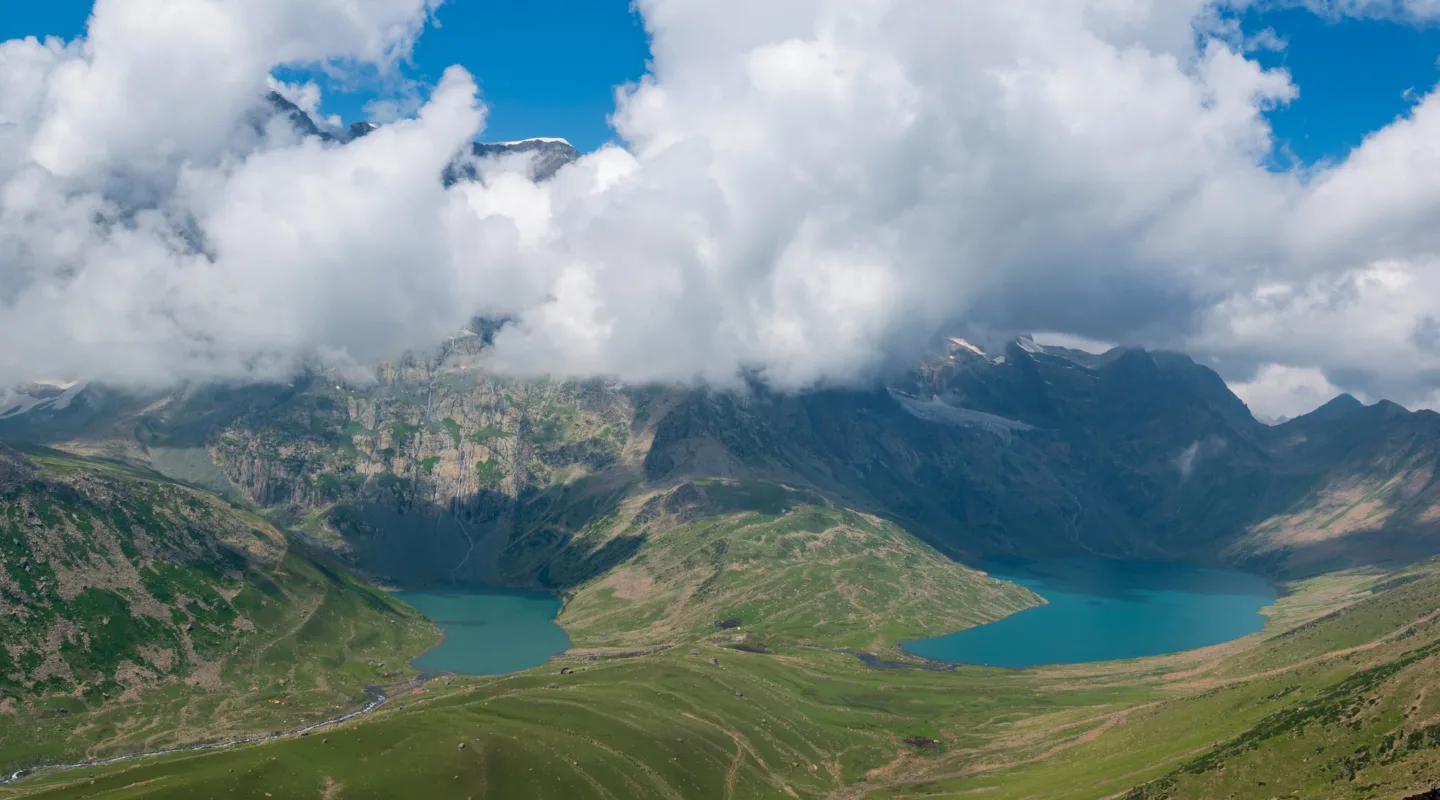

The Kashmir Great Lakes trek is the one trek in India where the landscape does the talking and the summit is almost incidental. Over seven days you cross three high passes in the Pir Panjal and camp beside seven glacial lakes, each a different shade of blue, with Mount Harmukh (5,142 m) standing over the last camp. It is often abbreviated to KGL.
It is also genuinely hard. This is not a first trek, and the numbers below explain why.
Kashmir Great Lakes at a Glance
| Detail | Information |
|---|---|
| Duration | 7 days / 6 nights |
| Price | ₹16,000 per person |
| Difficulty | Difficult |
| Total distance on foot | Approximately 68–72 km |
| Highest point | Gadsar Pass, 4,221 m (13,850 ft) |
| Start point | Shitkadi, near Sonamarg |
| End point | Naranag |
| Region | Pir Panjal range, Jammu & Kashmir |
| Group size | Maximum 12 travellers |
| Best season | July to September |
Why KGL Is Different From Other Himalayan Treks
Most Himalayan routes give you forest, then rock, then a summit. KGL gives you alpine meadow almost the whole way, punctuated by lakes. There is very little dense forest and very little boulder-hopping — what there is instead is altitude, distance and three passes in seven days.
The other thing that sets it apart is the rain shadow. The Pir Panjal acts as a shield, so while the rest of India is under monsoon downpour, the KGL valley is often dry and clear. That is why July and August, normally avoided in the Himalaya, are prime season here.
The 7-Day Itinerary, Day by Day
Day 1: Arrive Srinagar, drive to Sonamarg
A 90 km, roughly three-hour drive along the Sindh river to the base at Shitkadi near Sonamarg (2,730 m). The day is for briefing, gear check and acclimatisation. Do not skip the gear check — the passes ahead are cold even in August.
Day 2: Shitkadi to Nichnai via Shekdur
About 11 km and 7 to 8 hours. The real walking starts here, climbing steadily through pine, silver birch and maple before breaking out above the treeline to the Nichnai camp at 3,505 m.
Day 3: Nichnai to Vishansar Lake
About 12 km and 6 to 7 hours. You cross the Nichnai Pass at roughly 4,000 m and descend into a flower-strewn bowl to reach Vishansar (3,710 m), the first of the great lakes — deep blue in a glacial cirque. Krishansar sits just beyond it.
Day 4: Vishansar to Gadsar Lake via Gadsar Pass
The hardest day. You climb to Gadsar Pass at 4,221 m — the high point of the trek — then descend into the remote Gadsar valley to camp at 3,617 m. The pass is where fitness and acclimatisation get tested.
Day 5: Gadsar to the Satsar lakes
A traverse through the Satsar group, a chain of small lakes each a slightly different colour, camping at around 3,800 m. Shorter in distance but high and exposed.
Day 6: Satsar to Gangabal and Nundkol
The most spectacular camp of the trek. The twin lakes of Gangabal and Nundkol sit at 3,570 m directly beneath the sheer face of Mount Harmukh, with its hanging glaciers above. This is the image most people carry home.
Day 7: Gangabal to Naranag, drive to Srinagar
A long descent through forest to Naranag village, then the drive back to Srinagar. The knees take the punishment on this day, not the lungs.
How Hard Is the Kashmir Great Lakes Trek?
It is rated difficult, and that rating is earned. Three things combine: sustained altitude above 3,500 m for most of the trek, 68 to 72 km of walking in seven days, and three passes including one at 4,221 m.
You need prior multi-day trekking experience and comfort at altitude. If your only trekking has been weekend hills, this is not the one to start with. Build a base of several months of cardio and at least one multi-day trek before you book.
When to Go
July to September. The rain shadow means the monsoon months are actually the best window — the meadows are green, the lakes are full, and the weather is drier than the rest of India. September brings cooler nights and clearer air.
Avoid the shoulder months at either end: snow can linger on Gadsar Pass into June, and early October storms can close it.
The Seven Lakes
Vishansar, Krishansar, Gadsar, the Satsar group, Gangabal and Nundkol. Each has a distinct character: Vishansar is the deep glacial bowl, Gadsar the remote high valley, Satsar the chain of small jewels, and Gangabal with Nundkol the twin lakes under Harmukh.
What to Carry
Layers matter more than anything. A down jacket, fleece, thermal base layers, waterproof shell, gloves and a warm hat are all necessary even in August. Add trekking shoes with ankle support, a pole, water capacity of three litres, SPF 50+ sunscreen, sunglasses, personal medicines and a power bank. There is no resupply between Sonamarg and Naranag.
What the Package Covers
The ₹16,000 includes an experienced Kashmir guide and support staff, all camping equipment, all meals throughout, and the J&K Forest permit. Transport to Srinagar, personal porter charges and anything not listed are extra.
Frequently Asked Questions
Is the Kashmir Great Lakes trek suitable for beginners?
No. It is rated difficult and requires prior multi-day trekking experience plus comfort at altitude. The combination of 70 km, three passes and a 4,221 m high point makes it unsuitable as a first trek.
How many lakes do you actually see on the KGL trek?
Seven: Vishansar, Krishansar, Gadsar, the Satsar group, Gangabal and Nundkol. You camp beside most of them, which is what makes the route unusual.
What is the highest point of the Kashmir Great Lakes trek?
Gadsar Pass at 4,221 m (13,850 ft), crossed on day four. It is the crux of the trek and the day to pace yourself carefully.
Do I need a permit for the Kashmir Great Lakes trek?
Yes. The route passes through J&K Forest Department land, so a forest permit is required. It is included in the package and arranged before departure.
Planning Your Trip
Full inclusions and dates are on the Kashmir Great Lakes trek page. If you want a Kashmir trip without the altitude, our Kashmir backpacking trip covers the valley at a gentler pace. For other high-altitude options, compare the Hampta Pass trek and the Rupin Pass trek.
Hero photograph: Nundkol and Gangabal Lakes of Kashmir by Rohit Sharma, CC BY-SA 4.0, via Wikimedia Commons.
