
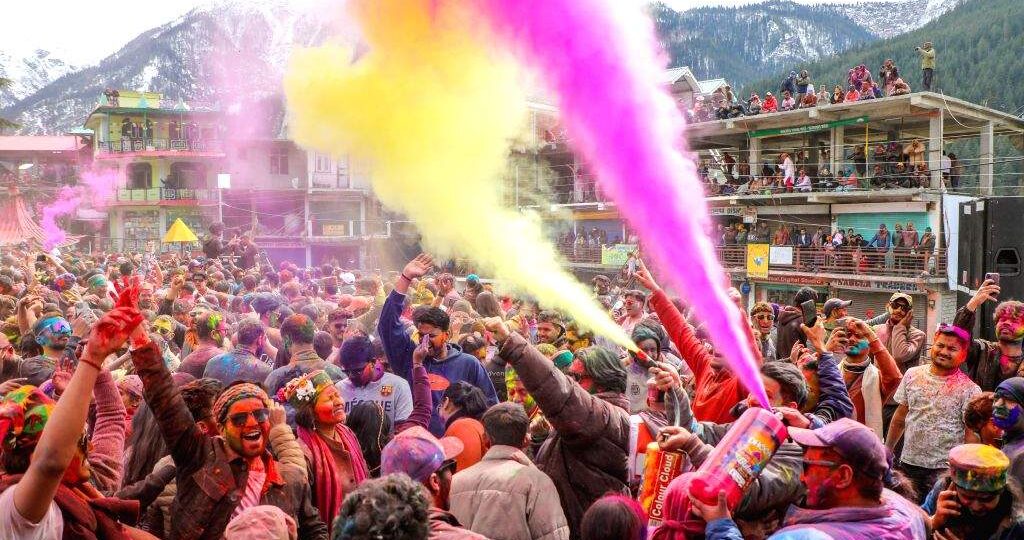
Sangla Holi Festival
In the modern world, we have “industrialized” our festivals. Holi, in most Indian cities, has become a predictable cycle of loud EDM, synthetic colors, and crowded rain dances. But if you head North—past the apple orchards of Shimla, through the terrifyingly beautiful cliff-hangers of the Hindustan-Tibet Highway, and into the deep embrace of the Baspa Valley—you will find a version of Holi that feels like it belongs to another century.
This is Sangla Holi, known locally as the Faguli Festival. And at Wanderers Nest, this isn’t just a trip on our itinerary; it is the soul of our road-tripping philosophy.
In this long-form guide, we invite you to understand why the Sangla Holi 2026 expedition is the most profound cultural experience you can have in the Himalayas.
1. The Legend of Faguli: More Than a Festival
To the people of Kinnaur, this time of year isn’t just about “Holi.” It is Faguli, a multi-day festival that marks the end of the winter’s “dark days.” For months, the valley remains buried under snow, isolated and quiet. Faguli is the awakening.
The Victory of Deities
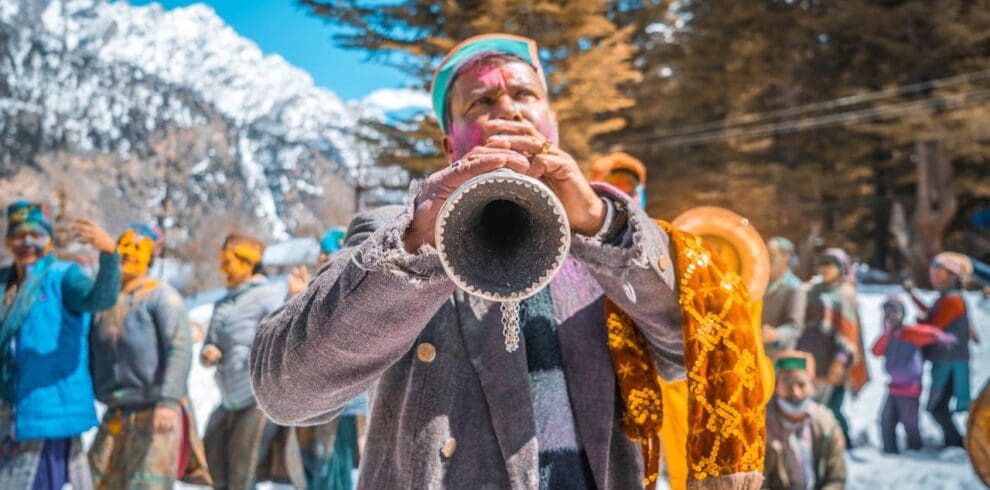
The festival is a symbolic battle between the local village deities and the “evil spirits” of the cold. In Sangla, the Bering Nag Devta is the protagonist. The festival involves bringing the deity out of the temple in a grand palanquin. The energy is primal. The sound of the Karnal (long brass trumpets) echoes off the granite walls of the valley, signaling to the mountains that spring has arrived.
The Ritual of the Totu
As a traveler with Wanderers Nest, you aren’t an outsider looking in through a camera lens. You are part of the circle. One of the most sacred moments is the distribution of Totu—a mixture of roasted barley flour and buttermilk. This isn’t just food; it’s a communal blessing. Sharing Totu with a Kinnauri elder while the sun hits the snow-capped peaks is a moment of pure, unadulterated human connection.
2. The Phagli Mask Dance: A Trance in the Snow
If there is one image that defines Sangla Holi 2026, it is the masks. The Phagli dance is the centerpiece of the celebration.
The Costume and the Craft
The men of the village don traditional attire—heavy woolens, green velvet Kinnauri caps, and skirts made of wild grass. But the focus is on the masks. These are hand-carved wooden faces, some centuries old, representing ancestors and spirits.
The Dance of the Spirits
As the drums (Dhol and Nagara) begin their rhythmic, hypnotic beat, the masked dancers enter a trance-like state. They perform street plays depicting the Ramayana, but with a distinct Himalayan twist. Seeing these ancient “spirits” dance in the middle of a snow-dusted village square, with the Kinner Kailash range looming 20,000 feet above, is enough to give even the most seasoned traveler goosebumps.
3. The “Last Village” Road Trip: The Wanderers Nest Way
At Wanderers Nest, we are road trippers first. We believe the story starts the moment we pick you up. The drive to Sangla is legendary, and in March, it is a feat of adventure.
The Gateway of Kinnaur
We drive through the “Taranda Dhank,” a stretch of road literally carved into a vertical cliff. It is often called one of the most dangerous roads in the world, but with our veteran Himalayan drivers, it becomes a front-row seat to the raw power of the Sutlej River carving through the mountains.
Chitkul: The Edge of the World
While most tourists stay in Sangla, we take the “Nest” further. We drive to Chitkul, the last inhabited village on the Indo-Tibetan border.
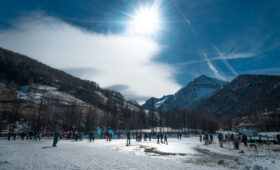
- Holi in the Snow: In March, Chitkul is usually a white desert. Playing Holi here means dry Gulaal on fresh snow.
- The Silence: There is a specific kind of silence in Chitkul that you can’t find anywhere else. It’s the sound of the wind coming from Tibet, the rustle of the frozen Baspa, and the distant ringing of temple bells.
4. The “Slow Travel” Philosophy: Why Join the Nest?
Why choose Wanderers Nest for your Sangla Holi 2026 experience? Because we don’t believe in “Point A to Point B” tourism.
Small Group Camaraderie
We don’t do 50-person buses. Our road trips are intimate. You’ll be sharing a vehicle with 5 or 6 other “Wanderers”—photographers, writers, corporate escapees, and solo travelers. By the time we reach the Baspa Valley, you aren’t a tour group; you are a tribe.
Authentic Stays
We ditch the luxury hotels for authentic, cozy homestays.
- The Vibe: Imagine a wooden attic room, a heavy buckwheat quilt, and the smell of cedar wood burning in the Bukhari (mountain heater).
- The Food: You’ll eat what the locals eat—Kinnauri Rajma, Siddu with ghee, and perhaps a sip of Phasur, the local grape wine that is brewed specially for the festival.
5. Photography and the “Golden Hour”
For photographers, Sangla Holi 2026 is the ultimate challenge and reward.
- The Contrast: The vibrant pinks, yellows, and greens of the Gulaal against the monochromatic white of the snow and the deep blue of the Himalayan sky.
- The Portraits: The faces of Kinnaur tell a story of resilience and warmth. The wrinkled smiles of the grandmothers and the fierce energy of the Phagli dancers provide endless “National Geographic” moments.
- The Kinner Kailash: If we are lucky with the weather, the “Shivling” peak of the Kinner Kailash reveals itself during the sunset, turning a fiery orange while the village below celebrates in the shadows.
6. Preparing for the High-Altitude Holi
This isn’t your average weekend getaway. To enjoy the Faguli Festival with Wanderers Nest, you need to be prepared.
- The Cold: Temperatures in March can drop to -5°C or -10°C at night. Layers are your best friend.
- The Altitude: Sangla sits at nearly 9,000 feet. We pace our road trip to ensure you acclimatize properly, but hydration is key.
- The Respect: This is a religious festival. We teach our travelers the etiquette of the mountains—how to ask for a photo, how to walk clockwise around temples, and how to leave no trace of plastic behind.
[…] The White Holi: A Journey into the Soul of Kinnaur with Wanderers Nest […]