
What Is Faguli Festival 2026?
When the plains of India begin to heat up in March, a mystical transformation takes place in the high-altitude reaches of the Kinnaur Valley. While most people associate Holi with the boisterous celebrations of Mathura or the modern pool parties of Delhi, there exists a celebration so ancient, so pure, and so visually spectacular that it feels like a glitch in time. This is Sangla Holi 2026, also known as the Faguli Festival 2026.
At Wanderers Nest, we don’t just organize trips; we facilitate deep cultural bridges. For us, the Sangla Holi expedition is the crown jewel of our road trip calendar. In this 1200-word deep dive, we explore why this festival is the ultimate bucket-list experience for every true traveler and why Wanderers Nest is the only way to experience it.
The Sacred Roots: Understanding the Faguli Festival
To understand why Sangla Holi is so special, one must first understand Faguli. Unlike the one-day celebration in the rest of India, Faguli is a multi-day festival that marks the transition from the “White Winter” to the “Colorful Spring.” In the local Kinnauri dialect, it represents the victory of the local deities over the demons of winter.
The Ritual of Totu
One of the most heartwarming aspects of the festival is the distribution of Totu. This is a sacred prasad made from roasted barley flour and buttermilk. As a traveler with Wanderers Nest, you aren’t just an observer; you are invited into the circle to share this meal, symbolizing that under the eyes of the mountain gods, everyone is equal.
The Visual Spectacle: The Carnival of Masks
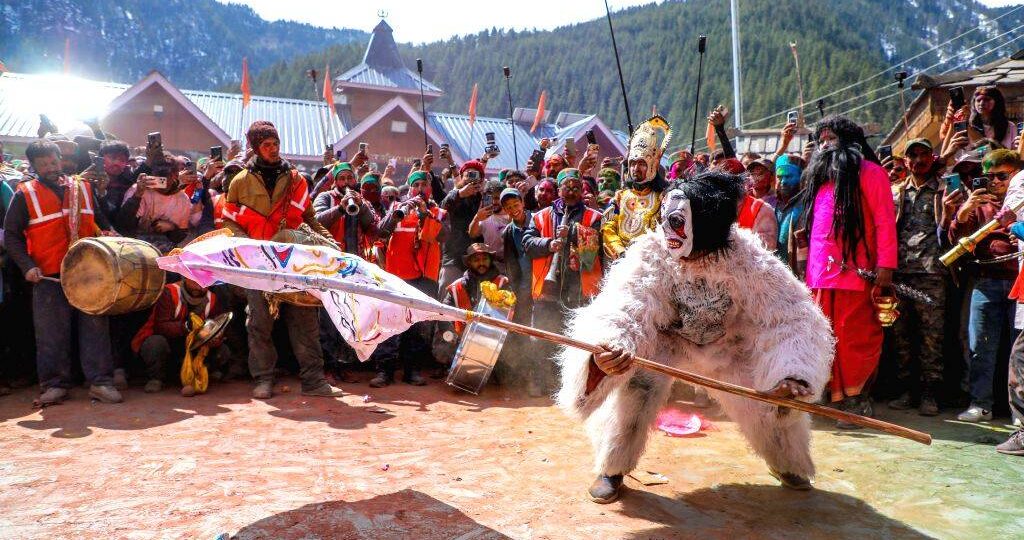
If you search for the most unique festivals in India, the Phagli Mask Dance of Kinnaur will always appear. This is where Sangla Holi separates itself from any other celebration on Earth.
The Performers
Local men, chosen through traditional rituals, wear heavy, hand-carved wooden masks that have been passed down through generations. They don skirts made of wild grass and perform rhythmic dances that depict the “Ramayana” and other local folklores.
The Symbolism
These masks represent various spirits and ancestors. The dancers move in a trance-like state, and witnessing this in the shadow of the Kinner Kailash range is a spiritual experience. The contrast of the dark wooden masks against the vibrant colors of the Gulaal and the pristine white snow is a photographer’s paradise.
The Geography of Joy: From Shimla to the Last Village
A Wanderers Nest trip to Sangla is as much about the journey as it is about the destination. The road to Kinnaur is famously known as one of the “World’s Most Dangerous Roads,” but it is also one of the most beautiful.
The Gateway: Shimla to Sarahan
Our journey begins in the colonial capital of Shimla, winding through the apple orchards of Narkanda. We stop at Sarahan, home to the Bhimkali Temple, a rare example of Indo-Tibetan wooden architecture. This serves as the perfect introduction to the unique culture you are about to witness in Sangla.
The Heart: Sangla Valley
Sangla, situated at an altitude of 8,900 feet, is the base of our festivities. The valley is flanked by giant mountains and the turquoise Baspa River. During Sangla Holi 2026, the entire valley smells of wild flowers and cedar wood.
The Edge: Chitkul – The Last Indian Village
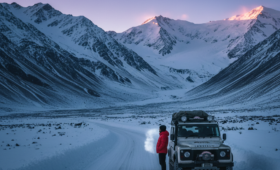
No Wanderers Nest expedition is complete without a visit to Chitkul. Located at 11,320 feet, it is the last inhabited village before the Indo-Tibetan border. During Holi, Chitkul is often still buried under 3–4 feet of snow. Playing with colors in a snow-covered village at the edge of the world is a memory that defines the word “adventure.”
Why Wanderers Nest is the Expert in Kinnaur Travel
You can visit Sangla with any tour operator, but you can only experience it with Wanderers Nest. Here is what sets us apart:
1. Local Immersion over Sightseeing
Most companies take you to a viewpoint and call it a day. We take you into the homes of the locals. Because of our long-standing relationships with the Kinnauri community, our guests are often invited to join the private community feasts and temple rituals that are usually closed to the public.
2. Expert Himalayan Drivers
The Hindustan-Tibet Highway (NH5) is not for the faint of heart. Our drivers are Himalayan veterans who understand the terrain, the weather patterns, and the “Cliffhanger” sections of the road. Your safety is our absolute priority.
3. Curated Stays
We avoid commercial hotels. Instead, we stay in riverside camps or boutique homestays that offer authentic Kinnauri hospitality. Imagine waking up to a view of the snow-peaked Kinner Kailash while sipping on warm salt tea (Cha).
4. Small Group Ethics
We don’t believe in 50-person bus tours. Our groups are small and intimate, allowing for a “tribe” feeling. You start the trip as a stranger and leave as part of the Wanderers Nest family.
The Sensory Experience: Food, Wine, and Music
Sangla Holi 2026 is a feast for the senses.
- The Taste: You will sample Phasur, the local grape wine that is brewed in every household for the festival. It is strong, sweet, and warms you up instantly in the sub-zero temperatures.
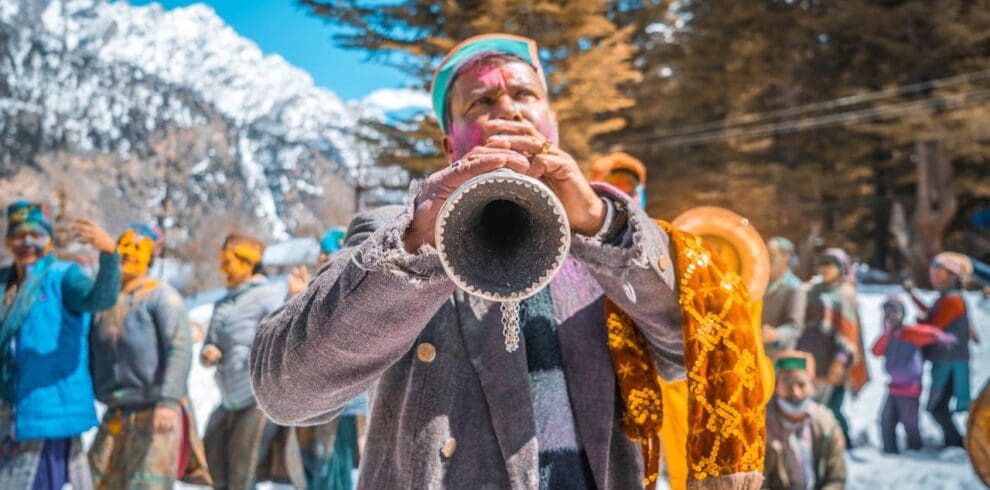
- The Sound: The Nati (local folk dance) music is infectious. You will find yourself holding hands with strangers, moving in a circular rhythm that has remained unchanged for centuries.
- The Sight: The “Choli” (traditional Kinnauri cap) with its green velvet trim becomes a sea of green in the crowd, often dusted with pink and yellow powder.
Travel Advice: Preparing for Sangla Holi 2026
This is a high-altitude trip, and preparation is key to enjoying the Faguli Festival to the fullest.
Weather and Clothing
March in Kinnaur is still winter. Temperatures in Sangla can range from 10°C during the day to -5°C at night. In Chitkul, it can be even colder.
- Must-Haves: Heavy down jackets, thermal inner-wear, waterproof trekking shoes, and UV-protected sunglasses (to prevent snow blindness).
Sustainability and Respect
The Kinnaur Valley is a fragile ecosystem. At Wanderers Nest, we follow a strict “Leave No Trace” policy. We use only organic, dry Gulaal and encourage our guests to bring back their plastic waste. Furthermore, we teach our guests how to respectfully photograph the local deities and elders—always ask for permission first!
Book Your Sangla Holi 2026 Experience Today!
Visit for Celebration Details In Sangla Holi Dates and Guide
[…] Kinnauri […]